 Tallynight
How to keep score in Skat
In Skat only the declarer scores. Win, and the game's value goes on your total. Lose, and twice that comes off. At the end of the list, the Seeger-Fabian system adds 50 for every game you won and gives the opponents points for every game the declarer lost.
- Players
- 3, or 4 with the dealer sitting out
- Who wins
- Highest total at the end of the list
- Each game
- Base value × multiplier
- A list
- 36 games at 3, 48 at 4 in tournaments
Base values (Grundwerte)
A suit game or a Grand is worth its base value times a multiplier, worked out below. Null games always have the same fixed value. These follow the International Skat Order (Internationale Skatordnung).
| Game | Base value |
|---|---|
| Diamonds (Karo) | 9 |
| Hearts (Herz) | 10 |
| Spades (Pik) | 11 |
| Clubs (Kreuz) | 12 |
| Grand | 24 |
| Null, fixed value | 23 |
| Null Hand, fixed value | 35 |
| Null ouvert, fixed value | 46 |
| Null ouvert Hand, fixed value | 59 |
Working out the multiplier
For suit games and Grand, add up these and multiply the total by the base value:
- Spitzen (matadors): 1 for each top trump in an unbroken run from the jack of clubs, either with them (you hold them) or without them (you're missing them)
- Game (Spiel): 1, always
- Hand (you didn't pick up the skat): 1
- Schneider (the losing side has 30 card points or fewer): 1
- Schneider announced (Hand games only): 1
- Schwarz (the losing side took no trick): 1
- Schwarz announced (Hand games only): 1
- Ouvert (open, Hand games only): 1
So hearts with 1, game 2, is 2 × 10 = 20. Grand with 2, game 3, is 3 × 24 = 72. The declarer needs 61 of the 120 card points (Augen) to win.
Winning, losing and overbidding
Win, and the game's value goes on the declarer's total. Lose, and twice the value comes off. The two opponents score nothing in the game points either way.
If the game turns out to be worth less than you bid (überreizt), you lose, even with 61 or more. The loss is twice the smallest multiple of the base value that reaches your bid: bid 24, play diamonds worth 18, and you lose 2 × 27 = 54.
Settling up with Seeger-Fabian
The official way to settle a Skatliste, the Abrechnung, is the Seeger-Fabian system in the International Skat Order. After the last game of the list, add to each player's game points:
- +50 for every game you won as declarer
- −50 for every game you lost as declarer
- +40 for every game someone else lost while you were an opponent, at a 3-player table
- +30 for every game someone else lost at a 4-player table, for the two opponents and for the dealer who sat out
The 50s mean that many small wins count, not only a few big games, and the 40s reward good defence. Tournaments play lists of 36 games at 3-player tables and 48 at 4-player tables, so everyone deals 12 times.
House rules that change the score
- Kontra and Re: an opponent says Kontra to double the game's score, and the declarer can answer Re to double it again.
- Ramsch: when everyone passes, play Ramsch instead of dealing again. The player with the most card points loses a fixed amount or their card points, as you agree. Official play has no Ramsch.
- Bockrunden: after an agreed event, such as a big game lost, a round where every game counts double, as some Doppelkopf tables play too.
- A plain list: some casual tables skip Seeger-Fabian and compare the game points only.
A scoring example
Ana, Ben and Cleo play a short list of 6 games at a 3-player table. In each game only the declarer scores. Then they settle up with Seeger-Fabian.
| Ana | Ben | Cleo | |
|---|---|---|---|
| Game 1 · Ana, hearts with 1, won | 20 | 0 | 0 |
| Game 2 · Ben, Grand with 2, won | 0 | 72 | 0 |
| Game 3 · Cleo, clubs without 1, lost | 0 | 0 | −48 |
| Game 4 · Ana, Null, won | 23 | 0 | 0 |
| Game 5 · Ben, spades with 1, Schneider, won | 0 | 33 | 0 |
| Game 6 · Ana, diamonds with 2, lost | −54 | 0 | 0 |
| Game points | −11 | 105 | −48 |
| +50 for each game won, −50 for each lost | 50 | 100 | −50 |
| +40 for each game an opponent lost | 40 | 80 | 40 |
| Seeger-Fabian total | 79 | 285 | −58 |
Clubs without 1, game 2, is 2 × 12 = 24, lost double: −48. Diamonds with 2, game 3, is 3 × 9 = 27, lost double: −54. Ana won 2 and lost 1, so she gets 50, and 40 more because she was an opponent when Cleo lost. Ben won 2 and was an opponent in both lost games: 100 + 80.
Keep score for Skat in Tallynight
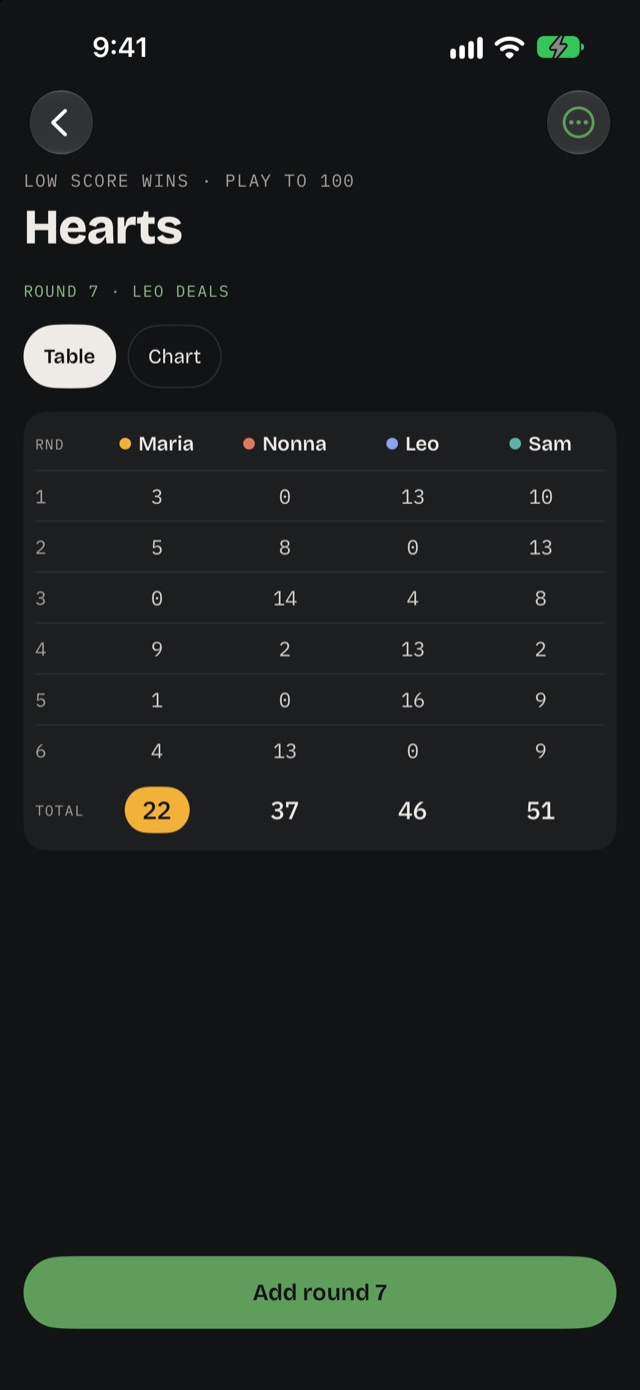
Skat is set up for you: rounds, highest score wins. After each game, type the declarer's value, or minus twice the value if they lost, and 0 for the others. The table keeps the running totals, like a Skatliste.
To settle with Seeger-Fabian as you go, give the declarer their value plus 50 for a win. For a loss, give them minus twice the value and minus 50 more, and give each opponent 40 (or 30 to each of the other three at a 4-player table). The totals then match the Abrechnung at the end.
- Every game in one table, with the running totals
- A minus sign for lost games
- Tap any game to fix an entry
- Play as many games as your list has, then tap End game
A Skat score sheet to print
Playing on paper tonight? Print a free Skat score sheet, or save it as a PDF.
Questions
How do you calculate the game value in Skat?
Add the Spitzen (with or without), 1 for the game and 1 each for Hand, Schneider, Schwarz and any announcements. Multiply that by the base value: clubs 12, spades 11, hearts 10, diamonds 9, Grand 24. Null games have fixed values: 23, 35, 46 or 59.
What happens when the declarer loses in Skat?
They lose twice the game's value. With Seeger-Fabian they also lose 50, and each opponent gets 40 at a 3-player table, or the other three get 30 each at a 4-player table.
What is the Seeger-Fabian system in Skat?
The official way to settle a Skatliste. After the list, each player gets 50 for every game they won and loses 50 for every game they lost, and gets 40 (30 at a 4-player table) for every game they saw the declarer lose.
How much is a Grand worth in Skat?
The base value is 24, so the smallest Grand, with or without 1, is worth 48. A Grand with 4 Spitzen and Schneider is 6 × 24 = 144.
What is a Skatliste?
The score sheet for Skat, also called a Spielliste. Each game is written for the declarer and added to their running total, and the list is settled at the end.
Do the opponents score in Skat?
Not in the game points: only the declarer does. Under Seeger-Fabian they get 40 each (30 at a 4-player table) for every game the declarer loses.