 Tallynight
How to keep score in Scala 40
In Scala 40, points are bad. When someone closes, everyone else adds up the cards left in their hand. Reach 101 and you're out, and the last player still in wins.
- Players
- 2 to 6
- Who wins
- The last player under 101
- Cards
- 2 decks and 4 jokers, 13 each
- To open
- 40 points of melds
What cards left in hand cost
The player who closes scores 0. Everyone else adds up what's still in their hand and writes it on their running total.
| Card | Points |
|---|---|
| Jolly (joker) | 25 |
| Ace | 11 |
| King, queen, jack | 10 |
| Two to ten | Face value |
In a meld, a joker counts as the card it stands for, and an ace counts 1 in ace, two, three. Those values matter for the 40 you need to open, not for the score.
Opening and closing
Before you can lay off cards on the table, your first melds must add up to at least 40 points. That's the 40 in the name. You play with the same two decks and four jokers as Burraco.
You close (chiusura) by melding or laying off all your cards but one and discarding it. The hand is over, and everyone else counts what they still hold.
Out at 101, and re-entry
Keep a running total for each player. Anyone who reaches 101 or more is out, and the others play on. The last player still under 101 wins.
Some tables play re-entry (rientro): a player who's out can come back in with the same score as the highest player still in. Agree before you start how many times you can re-enter, and whether it costs a new stake.
Variants that change the score
- Not opened: when someone closes, a player who hasn't opened yet scores a flat 100, whatever their cards.
- Closing in one go (chiusura in mano): melding all your cards in one turn without having opened before. Some tables count everyone else's cards double.
- Higher limit: play to 151 or 201 for a longer game.
- No elimination: keep going until someone reaches an agreed total, like 1,000, and the lowest score wins.
A scoring example
Three players, four hands. Ben closed hands 1 and 4, Ana hand 2 and Cleo hand 3.
| Hand | Ana | Ben | Cleo |
|---|---|---|---|
| 1 | 23 | 0 | 41 |
| 2 | 0 | 35 | 52 |
| 3 | 12 | 30 | 0 |
| 4 | 48 | 0 | 25 |
| Total | 83 | 65 | 118 |
Cleo passed 101 in hand 4, so she's out, and Ana and Ben play on. With re-entry, Cleo comes back in on 83, Ana's score, the highest still in.
Keep score for Scala 40 in Tallynight
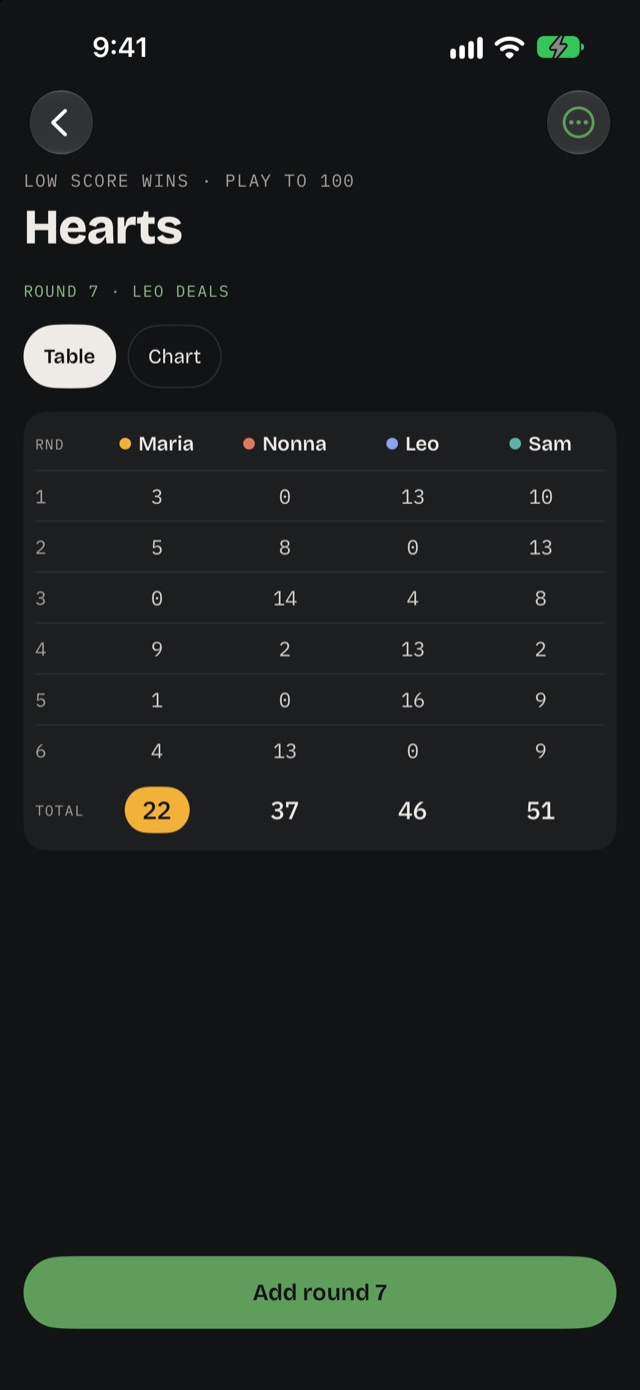
Scala 40 is set up for you: rounds, lowest score wins, to 101. After each hand, type 0 for whoever closed and everyone else's cards on one keypad. The table keeps the totals and who's in front.
When someone reaches 101, Tallynight offers to end the game. With three or more players, carry on: type 0 for anyone who's out, and the last player under 101 finishes with the lowest total. For re-entry, take the difference off in the next hand with a minus sign (−35 brings Cleo from 118 to 83).
- Offers to end the game when someone reaches 101
- Play to 151 or 201 by changing the target
- Tap any hand to fix a miscount
- A race chart that replays the game at the end
A Scala 40 score sheet to print
Playing on paper tonight? Print a free Scala 40 score sheet, or save it as a PDF.
Questions
How many points do you need to open in Scala 40?
40, from melds laid down in one turn. A joker counts as the card it replaces, and an ace counts 1 in ace, two, three and 11 elsewhere.
How much is a joker worth in Scala 40?
25 points if it's still in your hand when someone closes. In a meld it takes the value of the card it stands for.
When are you out in Scala 40?
When your total reaches 101 or more. The others play on, and the last player under 101 wins. Some tables play to 151 or 201.
How does re-entry work in Scala 40?
In the re-entry variant (rientro), a player who reaches 101 comes back in with the same score as the highest player still in. Agree beforehand how many times it's allowed.
What does the player who closes score in Scala 40?
0 for that hand. Everyone else scores the cards left in their hand.