 Tallynight
How to keep score in Bunco
Bunco is played at tables of four, in pairs, over sets of six rounds. In each round you roll three dice for that round's number. When a team at the head table reaches 21, the round ends at every table and everyone marks a win or a loss. Most wins at the end of the night takes the top prize.
- Players
- 12 is classic: three tables of four, in pairs
- Who wins
- Most rounds won, with prizes for buncos too
- Dice
- Three at each table
- A night
- 2 to 4 sets of six rounds
What each roll scores
Each die counts on its own: the dice aren't added together. In round 1 you want 1s, in round 2 you want 2s, and so on up to 6s in round 6.
| Roll of three dice | Points |
|---|---|
| Each die showing the round's number | 1 |
| Three of a kind of another number (a mini bunco) | 5 |
| Three of the round's number (a bunco) | 21 |
| None of the round's number, and no three of a kind | 0, and the dice pass on |
In round 4, a roll of 4 4 2 scores 2, 3 3 3 scores 5, and 4 4 4 is a bunco for 21. Keep rolling as long as each roll scores.
Turns, the head table and the end of a round
Partners sit opposite each other. Take turns rolling all three dice, and keep going as long as each roll scores. A roll that scores nothing passes the dice to the left. One scorekeeper at each table adds up both teams' points.
The head table sets the pace. When a team there reaches 21 points, someone rings the bell and the round ends at every table. A player in the middle of a turn usually finishes it first. A bunco is 21 on its own, so a bunco at the head table ends the round straight away.
The other tables keep rolling until the bell, even past 21. When it rings, the team with more points at each table wins the round. A tie is settled with a roll-off: each player takes one more turn, and the team with more points wins.
Wins, losses and buncos
After each round, every player marks their own score card: a win if their team won the round, a loss if it lost. A player who rolls a bunco marks it on their own card too. Their partner doesn't.
At the end of the night, everyone adds up their wins, losses and buncos, and the prizes are handed out.
Moving tables and changing partners
Partners change every round. With three tables, a common way to move is:
- Head table: the winners stay and split up, so each has a new partner. The losers move down a table.
- Middle table: the winners move up to the head table, and the losers move down.
- Last table: the winners move up, and the losers stay and split up.
Some groups send the head table's losers to the last table instead. Any way works, as long as partners change every round.
Prizes, and how house rules vary
Bunco nights usually have several prizes, not one. The most common:
- Most wins: the top prize
- Most buncos
- Most losses: a prize for the unluckiest player
- Last bunco of the night
- Even: as many wins as losses
House rules vary from group to group. Some play two sets and some four, some don't score a mini bunco, and some pass a travelling prize to whoever rolls a chosen number. Agree before the first bell.
A scoring example
Round 3 at the head table, so 3s score. Ana and Cleo are Team A, Ben and Dev are Team B, and the dice go round the table: Ana, Ben, Cleo, Dev.
| Turn | Rolls | Scores | Team A | Team B |
|---|---|---|---|---|
| 1 | Ana: 3 5 1, then 3 3 6, then 2 4 6 | 1 + 2 + 0 | 3 | 0 |
| 2 | Ben: 6 6 6, then 3 1 2, then 5 5 1 | 5 + 1 + 0 | 3 | 6 |
| 3 | Cleo: 3 3 1, then 3 2 4, then 3 3 5, then 1 1 2 | 2 + 1 + 2 + 0 | 8 | 6 |
| 4 | Dev: 4 4 2 | 0 | 8 | 6 |
| 5 | Ana: 3 1 1, then 3 3 3 | 1 + 21 | 30 | 6 |
| End of round | 30 | 6 |
Ben's three 6s are a mini bunco, worth 5, because 6 isn't the round's number. Ana's three 3s are a bunco, which took Team A past 21, so the bell rang and round 3 ended at every table.
Ana and Cleo each mark a win, Ben and Dev a loss, and Ana marks a bunco on her own card. After six rounds, Ana's card might read 4 wins, 2 losses and 1 bunco. Then the next set starts again at 1s.
Keep the Bunco tally in Tallynight
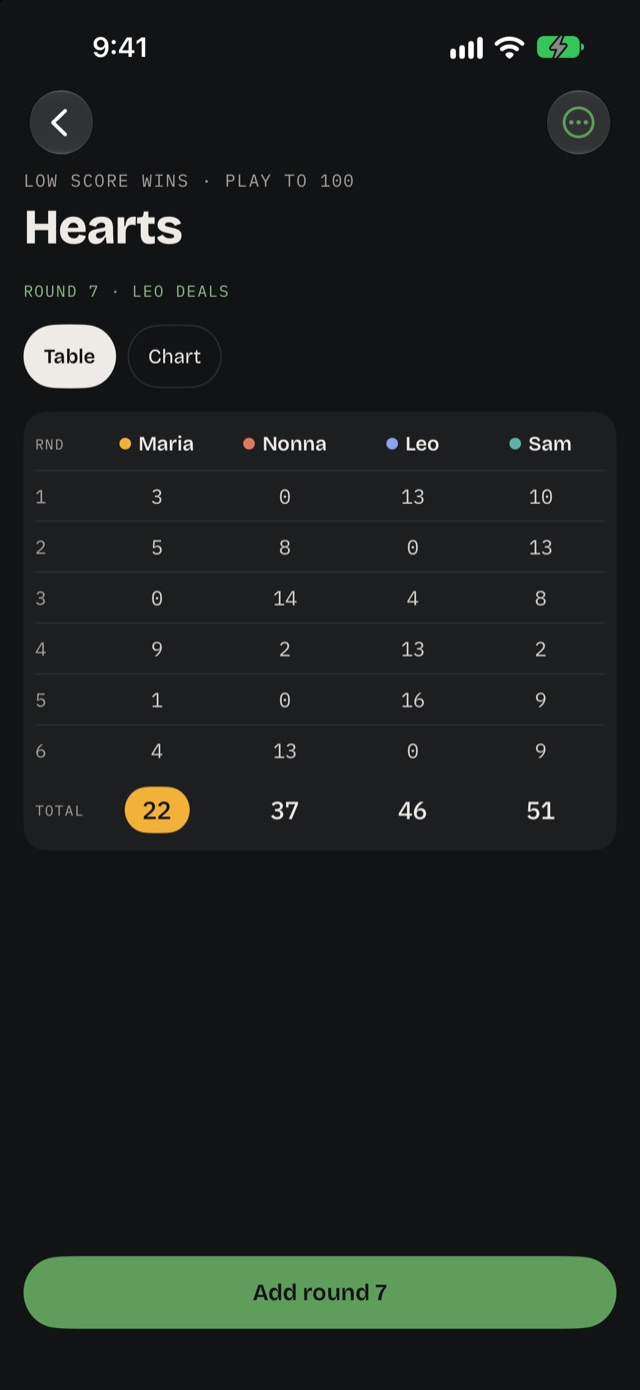
Bunco isn't one of Tallynight's built-in games yet, and Tallynight doesn't know its rules or who moves where. What it can do is keep the night's tally. Choose Something else, then Rounds, with the highest score winning, and add everyone as a player.
After each round, type 1 for every player who won and 0 for everyone who lost. The totals are everyone's wins, with the leader on top. Keep buncos on the score cards. Add it to your favourites and it's ready for next month.
- Everyone's round on one keypad: 1 for a win, 0 for a loss
- Wins add up as you go, with the leader on top
- Tap any round to fix a wrong mark
- Every finished night is kept, to settle who won last month
A Bunco score sheet to print
Playing on paper tonight? Print a free Bunco score sheet, or save it as a PDF.
Questions
How many points is a bunco worth?
21. A bunco is all three dice showing the round's number, like three 4s in round 4. At the head table, it ends the round straight away.
What is a mini bunco or baby bunco?
Three of a kind of any number that isn't the round's number, like three 2s in round 5. It's worth 5 points, and you keep rolling.
How many rounds are in a game of Bunco?
Six rounds make a set, one for each number on the dice. Most groups play two to four sets in a night, so 12 to 24 rounds.
Who wins at Bunco?
The player with the most wins at the end of the night. Most groups also give prizes for the most buncos, the most losses and the last bunco.
What happens if there's a tie in Bunco?
A tied round at a table is settled with a roll-off: each player takes one more turn, and the team with more points wins. Still tied? Go again.
Can you play Bunco with fewer than 12 players?
Yes. Use as many tables of four as you can fill. If you're one short at a table, play a ghost: an empty seat whose partner rolls for both of them.
Do you keep rolling after a bunco?
At the other tables, yes: a bunco scores, so you roll again. At the head table, a bunco takes your team to 21 and the round ends.