 Tallynight
How to keep score in 10,000
10,000 is played with six dice. On your turn you set aside dice that score, then bank your points or roll the rest. A roll with nothing that scores loses everything from that turn. When someone reaches 10,000, everyone else gets one last turn, and the highest total wins.
- Players
- 2 or more
- Who wins
- Highest total once someone reaches 10,000
- Dice
- Six
- Opening
- 500 in one turn to get on the board
10,000 scoring chart
Only dice from the same roll make a combination. After every roll, set aside at least one scoring die or combination. This is the chart most tables start from; the values that change most are under it.
| Dice in one roll | Points |
|---|---|
| Each 1 | 100 |
| Each 5 | 50 |
| Three 1s | 1,000 |
| Three 2s | 200 |
| Three 3s | 300 |
| Three 4s | 400 |
| Three 5s | 500 |
| Three 6s | 600 |
| Four of a kind | Double the three of a kind |
| Five of a kind | Double again |
| Six of a kind | Double again |
| Straight: 1 2 3 4 5 6 | 1,500 |
| Three pairs | 1,500 |
Doubling means four 3s are 600, five 3s 1,200 and six 3s 2,400. Four 1s are 2,000. A single 2, 3, 4 or 6 scores nothing on its own.
Charts vary more in 10,000 than in most dice games. A straight can be worth anything from 1,000 to 3,000, three pairs from 750 to 1,500, and some tables add the three of a kind again for each extra die instead of doubling (four 3s 600, five 3s 900). Agree on yours before the first roll.
Rolling, banking and losing a turn
Roll all six dice. Set aside at least one scoring die or combination, then either bank your turn total or roll the dice that are left. Keep going as long as every roll scores.
If a roll has nothing that scores, you lose everything from that turn and the dice pass on. Points you banked on earlier turns are safe.
If all six dice have scored, you have hot dice: pick up all six, roll again, and keep adding to the same turn total.
Getting on the board
Your first score has to be at least 500 in a single turn. Until you've banked that once, you can't stop below 500, so you keep rolling. After that, bank any amount you like.
Some tables ask for 1,000 to get on the board, or a minimum such as 350 on every turn.
Reaching 10,000
When someone banks 10,000 or more, every other player gets one last turn to beat that total. The highest score wins.
Some tables skip the last turns, and the first to 10,000 wins outright. Others play to 5,000 for a shorter game.
10,000 and Farkle: what's different
10,000 and Farkle are the same game: six dice, 1s and 5s, and a push to 10,000. Zilch, Greed and Dix Mille are other names for it. What changes is the chart. Boxed Farkle comes with a chart printed in the rules, while 10,000 is usually played from a chart handed down at home. The usual differences:
- Three 1s: 1,000 in 10,000. The boxed Farkle chart scores them 300.
- Four, five and six of a kind: usually doubled in 10,000. Boxed Farkle pays a flat 1,000, 2,000 and 3,000, whatever the number.
- Extra combinations: boxed Farkle adds four of a kind with a pair (1,500) and two sets of three (2,500). Without them, each part scores on its own.
The Farkle scoring guide has the boxed chart in full.
A scoring example
Three players near the end of a game, playing the chart above. Ana rolls first, then Ben, then Cleo.
| Ana | Ben | Cleo | |
|---|---|---|---|
| Before this round | 9,150 | 8,700 | 7,900 |
| This round | 1,000 | 0 | 2,350 |
| Final | 10,150 | 8,700 | 10,250 |
Ana rolled three 1s for 1,000 and banked it, which took her past 10,000. Ben and Cleo each had one last turn to beat 10,150.
Ben needed more than 1,450. He had 600 after two rolls, rolled on, and his next roll scored nothing, so his turn was worth 0.
Cleo rolled four 1s, worth 2,000 with doubling. With her last two dice she rolled two 5s for 100, so all six had scored: hot dice. She rolled all six again, set aside three 2s and a 5 for 250, and banked 2,350. Cleo wins, 10,250 to 10,150. On the boxed Farkle chart, those four 1s would have been worth 1,000.
Keep score for 10,000 in Tallynight
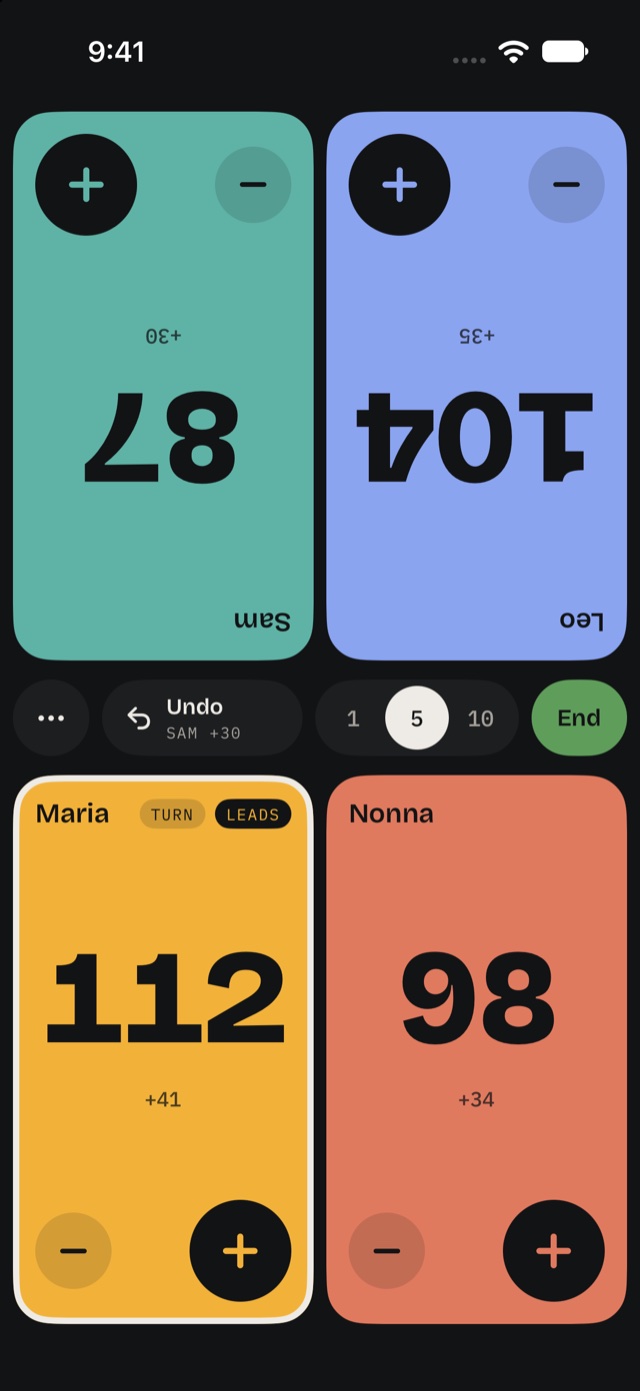
Tallynight's Farkle game is already set up the way 10,000 is played: a running score, highest wins, to 10,000, with 50, 100 or 500 a tap. Pick it, rename it 10,000 if you like, and add it to your favourites.
Tallynight doesn't know the dice combinations, so add up each turn yourself, then tap + or tap a total to type it. When someone passes 10,000, it offers to end the game. Give everyone their last turn first, then decide.
- Points per tap of 50, 100 or 500
- Whose turn it is, so nobody rolls twice
- Undo, and a scoring log to fix any turn
- Offers to end the game at 10,000, and you decide when
A 10,000 score sheet to print
Playing on paper tonight? Print a free 10,000 score sheet, or save it as a PDF.
Questions
How do you score the 10,000 dice game?
Each 1 is 100 and each 5 is 50. Three of a kind is 100 times the number, except three 1s, which are 1,000. A straight and three pairs are 1,500 each. Bank your points before a roll with nothing in it wipes out the turn.
How many points do you need to get on the board in 10,000?
500 in a single turn at most tables, and 1,000 at some. Until you've banked it once, you have to keep rolling.
How much is four of a kind in 10,000?
Usually double the three of a kind: four 2s are 400, four 5s are 1,000 and four 1s are 2,000. Each extra die doubles it again.
How much are three pairs worth in 10,000?
1,500 at most tables, and 750 or 1,000 at some. Three pairs use all six dice, so you have hot dice and can roll all six again.
Is 10,000 the same as Farkle?
Yes, under another name, like Zilch and Greed. The chart is what differs: boxed Farkle scores three 1s at 300 and four of a kind at a flat 1,000, where 10,000 usually scores 1,000 and doubles.
What happens when someone reaches 10,000?
Everyone else gets one last turn to beat their total, and the highest score wins. Some tables let the first to 10,000 win outright.